
Overcurrent protection devices, or OCPDs, are the essential safeguards of any electrical system. Think of them as automatic emergency brakes, engineered to shut down power before a problem escalates into a catastrophe. They are your primary defense against two major electrical threats: slow-burning overloads and violent short circuits. Without effective OCPDs, facilities risk overheated circuits, destroyed equipment, and a serious threat of fire.
Why Overcurrent Protection Devices Are Essential

Imagine your facility's electrical system as a network of highways. The current is the traffic, and the wires are the roads. Everything runs smoothly as long as the traffic flow (current) stays within the road's capacity (wire gauge). But when a sudden, massive traffic surge occurs, OCPDs become absolutely non-negotiable.
An overcurrent event is precisely what it sounds like—the current in a circuit spikes beyond its designated safe level. This dangerous condition typically manifests in one of two ways, each posing a unique threat to your equipment and personnel.
The Dangers of Overloads
An overload is like a persistent, slow-moving traffic jam. It occurs when too many devices on one circuit draw more power than the circuit was designed to handle. Picture plugging several high-powered industrial tools into a single circuit rated for just one machine.
The wires begin to heat up slowly but surely, much like an engine overheating in gridlock traffic. This gradual temperature rise can melt wire insulation, damage sensitive electronics, and severely degrade equipment over time. While not as explosive as a short circuit, a sustained overload is a major fire hazard and a leading cause of premature equipment failure.
The Threat of Short Circuits
A short circuit, in contrast, is a catastrophic, multi-car pile-up on the electrical highway. It happens when a low-resistance path is accidentally created, allowing an immense amount of current to flow instantaneously. This can result from damaged insulation, a loose connection, or even a stray piece of metal bridging two conductors.
The result is a violent, explosive release of energy that can cause:
- An arc flash, an explosive blast of heat and light that can cause severe burns and destroy equipment.
- Extreme mechanical forces strong enough to physically bend thick copper bus bars.
- Temperatures hot enough to vaporize metal and instantly ignite nearby materials.
At its core, an overcurrent protection device has one critical job: to detect these dangerous conditions and interrupt the power before the damage is done. It’s the system's emergency brake, stopping a small problem from becoming a costly disaster.
The growing reliance on these devices is clear. The global market for OCPDs hit around USD 15.3 billion in 2023, and it's not slowing down. Driven by the expansion of industrial automation and renewable energy, that number is expected to climb to USD 23.7 billion by 2028. You can find more details on this growth in the Market Report Analytics industry analysis.
Ultimately, understanding why you need overcurrent protection is the first step. It is about more than just compliance; it is about protecting assets, ensuring personnel safety, and maintaining operational continuity.
Choosing Your Shield: Fuses, Circuit Breakers, and Relays
Selecting the right overcurrent protection is like choosing the appropriate shield for a specific battle. A small buckler won’t stop a cannonball, and a massive tower shield is cumbersome in a knife fight. In the electrical world, your primary shields are fuses, circuit breakers, and protective relays, each designed with a specific threat in mind.
The first major decision often comes down to fuses versus circuit breakers. A fuse can be thought of as a single-use bodyguard. Inside is a thin metal strip designed to melt and instantly break the circuit the moment a dangerous current flows through it. It sacrifices itself to save your equipment, and once it blows, it must be replaced.
A circuit breaker, conversely, is like a resettable security guard. It uses a mechanism—either thermal for slow-burning overloads or magnetic for sudden short circuits—to trip and open the circuit path. Once the fault is cleared, you simply reset it. No replacements are needed, which is why circuit breakers are the standard choice for most applications.
The Workhorses: Molded Case and Miniature Circuit Breakers
Within the circuit breaker category, two types dominate the field: Molded Case Circuit Breakers (MCCBs) and Miniature Circuit Breakers (MCBs). They perform the same function but on different scales.
- Miniature Circuit Breakers (MCBs) are the compact devices found in residential panels or protecting small branch circuits. They’re designed for lighter loads, typically under 100 amps, and have a lower breaking capacity. They are ideal for lighting, outlets, and small appliances.
- Molded Case Circuit Breakers (MCCBs) are the industrial heavyweights. Built for durability, they handle significant currents—from 15 amps up to 2,500 amps—and are used to protect large motors, main feeder lines, and entire panelboards. A key advantage of many MCCBs is their adjustable trip settings, allowing you to fine-tune the protection for a specific piece of equipment.
For a comprehensive selection of industrial-grade circuit breakers, browse our collection of MCBs and MCCBs from trusted manufacturers. We ensure you have the right shield for everything from a small control circuit to a massive industrial feeder.
OCPD Comparison Fuses vs Circuit Breakers
A side-by-side comparison can help you make the right decision for your application. This table breaks down the key differences between the two most common types of overcurrent protection.
| Feature | Fuses | Circuit Breakers (MCCB/MCB) |
|---|---|---|
| Operation | A single-use element melts to interrupt the circuit. | An internal mechanism trips to open the circuit; can be reset. |
| Resetting | Must be physically replaced after tripping. | Can be manually reset after the fault is cleared. |
| Initial Cost | Generally lower initial cost per device. | Higher upfront cost compared to a single fuse. |
| Long-Term Cost | Requires stocking replacement fuses, leading to ongoing costs. | No replacement parts needed after a trip, lowering lifetime cost. |
| Best For | Protecting sensitive electronics and high fault current applications. | General-purpose protection in residential, commercial, and industrial settings. |
While both provide excellent protection, the decision often balances upfront cost with long-term convenience and operational needs.
The Intelligent Guardian: Protective Relays
If fuses and circuit breakers are the soldiers on the front line, a protective relay is the brain in the command center. It doesn't interrupt the current itself. Instead, it is a highly sensitive monitoring device that continuously observes system conditions like current, voltage, and frequency.
When a relay detects an issue—perhaps a subtle overload a standard breaker might ignore—it sends a signal to a larger circuit breaker to open and de-energize the circuit. This makes relays indispensable for protecting high-value assets like large motors, generators, and transformers where precision and advanced diagnostics are required.
A protective relay offers a level of smart, programmable protection that a standard breaker cannot match. It is sophisticated enough to distinguish between a normal motor starting current and a genuine fault, preventing unnecessary downtime while ensuring ultimate safety for your most critical equipment.
The entire market for these critical devices is expanding rapidly. The overcurrent protection sector was valued at USD 2.5 billion in 2024 and is expected to nearly double to USD 4.5 billion by 2034. A significant driver of this growth is the rise of electric vehicles and their charging infrastructure, which demand specialized and highly reliable protection. You can read more about these trends in the full industry report from Emergen Research.
Understanding these core differences is the first step toward designing an electrical system that is not just functional, but truly safe and resilient.
Sizing Your OCPD for Maximum Safety and Performance
Selecting the right overcurrent protection device (OCPD) is more than just matching numbers on a spec sheet. It's a critical balancing act—you need a device that prevents nuisance trips and unnecessary downtime but responds instantly when a real fault occurs. Let's move beyond theory and into the practical steps and metrics engineers use daily to size OCPDs correctly.
First, you cannot protect what you do not know. Proper OCPD sizing begins with a thorough understanding of the load. This means knowing the full load amps (FLA) of a motor or the total current draw of a branch circuit under normal operating conditions. That figure is the foundation of every subsequent safety calculation.
The National Electrical Code (NEC), for instance, provides clear starting points. For a continuous load—anything expected to run for three hours or more—the OCPD must be sized at 125% of the load current. This buffer accounts for heat buildup and ensures the device does not trip during normal operation.
Key Metrics You Cannot Ignore
Once you have determined the load current, it is time to evaluate the protective device itself. Two of the most critical specifications are its Interrupting Rating and its trip settings. These determine precisely how it will perform under fault conditions.
- Interrupting Rating (IR) or Ampere Interrupting Capacity (AIC): This is arguably the most important safety rating on any OCPD. It specifies the absolute maximum short-circuit current the device can safely interrupt without failing catastrophically (i.e., exploding). Your device's IR must be equal to or greater than the available fault current at its point of installation.
- Trip Settings: For advanced devices like Molded Case Circuit Breakers (MCCBs), you can fine-tune the protection. Key settings like pickup (the current level that initiates the trip process) and time delay (how long it waits before tripping) allow you to customize protection for specific loads, such as a motor with a high starting current.
An undersized Interrupting Rating is a serious safety hazard. If a fault current exceeds the device’s rating, the OCPD can rupture, causing a dangerous arc flash and destroying equipment. This is a non-negotiable specification that must be verified for every installation.
A Real-World Sizing Example
Let's walk through a common industrial scenario: sizing protection for a 25-horsepower, 460V, 3-phase induction motor.
- Find the Full-Load Current (FLA): A check of NEC Table 430.250 shows that a motor with these specifications has an FLA of 34 amps.
- Calculate the Max Breaker Size: To accommodate the high inrush current when the motor starts, the NEC permits the breaker to be sized up to 250% of the FLA. The calculation is: 34A x 2.50 = 85A. Since 85A is not a standard size, you would select the next standard size up, which is a 90-amp breaker.
- Verify the Interrupting Rating: This is the critical safety check. You must calculate the available fault current at the motor's location. If your analysis shows a potential fault of 18,000 amps, a standard 10kA (10,000A) breaker is unsafe. You must select a breaker with an AIC of 22kA (22,000A) or higher.
Fine-Tuning with Trip Adjustments
For more sophisticated machinery, the adjustable trip settings on an MCCB provide an incredible level of precision. Consider a conveyor belt motor that sometimes experiences brief jams.
- Long-Time Setting: This provides overload protection. You would set it slightly above the motor's FLA to handle normal, sustained operation.
- Short-Time Setting: This setting allows for brief current spikes without tripping, perfect for allowing a momentary jam to clear itself without shutting down the entire line.
- Instantaneous Setting: This is the emergency brake. It is set high enough to ignore the motor's normal starting surge but will trip instantly on a direct short circuit.
Choosing the right OCPD is a methodical process that requires knowing the load, following code, and always verifying safety ratings. Whether you're protecting a simple branch circuit or a complex motor control system, having the right device is critical. Our deep inventory of molded case circuit breakers offers a wide range of trip units and interrupting ratings, so you can find the precise OCPD you need to keep your systems safe and productive.
Mastering Coordination with Time-Current Curves
When a minor fault occurs in a large industrial facility, it should not cause a facility-wide shutdown. That is the principle behind selective coordination—a smart design strategy that ensures only the overcurrent protection device (OCPD) closest to the fault trips, leaving the rest of the system operational.
Think of it as a chain of command: a local issue is handled by the local officer, not by dispatching the entire police force. This is precisely how a well-coordinated electrical system should function.
Achieving this level of reliability is a science, and the primary tool for the job is the Time-Current Curve (TCC). These graphs are the key to designing a truly resilient power system, giving engineers a visual map of how different circuit breakers and fuses will behave under fault conditions.
Decoding the Time-Current Curve
At first glance, a TCC chart can appear to be a complex web of lines. However, it is a straightforward plot showing how long it takes for a specific OCPD to trip at any given level of current.
- The vertical axis represents time, typically in seconds.
- The horizontal axis represents current, measured in amps.
Each curve on the graph represents one device, illustrating a simple relationship: at lower fault currents (slightly above the device's rating), the device will take longer to trip. But during a massive short circuit, the trip time becomes nearly instantaneous—often just a fraction of a second.
This process highlights the core steps: you identify a load, calculate its needs, and then select the right OCPD. It’s the starting point for any coordination study.
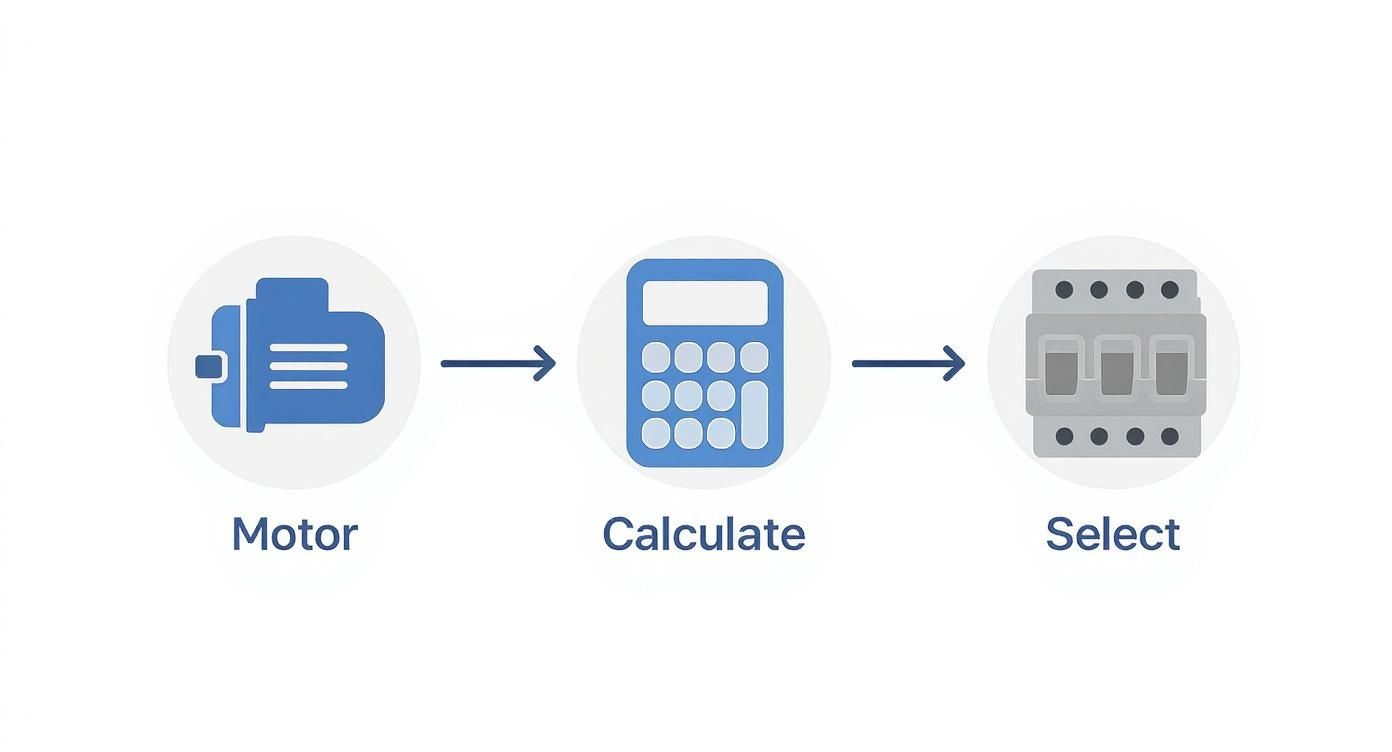
As the diagram shows, picking the device comes last, right after you’ve done the math on your circuit's requirements.
Achieving Selective Coordination
The real value of TCCs becomes apparent when you layer the curves for multiple devices—such as a small branch circuit breaker and the larger main breaker feeding it—on the same graph. The objective is simple: ensure their curves never overlap.
For a system to be selectively coordinated, the curve of the downstream device (closer to the load) must sit entirely below the curve of the upstream device (closer to the power source), with a clear gap between them at all potential fault current levels.
If the curves touch or cross, a "miscoordination zone" is created. In this zone, both breakers could trip simultaneously, turning a minor inconvenience into a major outage. Proper coordination guarantees that for any fault on the branch circuit, only the smaller, local breaker trips. The main breaker—and the rest of your facility—remains energized.
TCCs in Practice
Let’s consider a quick example. Imagine you have a 20-amp MCB protecting a motor, and that circuit is fed by a 100-amp MCCB at the main distribution panel.
- Plot the Curves: An engineer obtains the TCCs for both the 20A MCB and the 100A MCCB and plots them on the same graph.
- Analyze for Overlap: They examine the two curves closely to ensure the entire 20A curve lies below the 100A curve, with no intersections.
- Adjust if Needed: If there is an overlap, particularly in the high-current instantaneous trip region, a change is necessary. The engineer might adjust the trip settings on the 100A MCCB or select a different model to create the critical separation.
Becoming proficient with TCCs changes how you approach electrical protection. It shifts the focus from protecting a single piece of equipment to designing an intelligent, layered defense system that maximizes uptime and minimizes disruptions.
For professionals building reliable systems, access to OCPDs with well-documented TCC data is a necessity. At Kent Electrical Supply, we provide detailed technical specifications for our lineup of industrial circuit breakers, giving you the data required to perform accurate coordination studies and build robust electrical systems.
Applying OCPDs in Real-World Scenarios

Understanding the theory behind overcurrent protection is one thing, but applying it effectively on the factory floor or in a critical facility requires practical expertise. Choosing the right device is not just about compliance; it is about matching the protection to the unique demands of the load.
A large industrial motor, for example, behaves differently than a sensitive control circuit. The motor requires a device—like a Molded Case Circuit Breaker (MCCB) with adjustable trip settings—that can tolerate the massive but normal current spike during startup. Applying a hyper-sensitive breaker to that motor will only lead to nuisance trips and costly downtime.
Protecting High-Stakes Motor Circuits
Motors present one of the most challenging applications for any overcurrent device. The initial startup current can surge to 5 to 8 times the motor's normal running amperage. To a standard breaker, this can look like a short circuit.
This is precisely why specialized motor protection exists. An MCCB or a dedicated motor protector is designed for this type of service. Its trip curve is engineered to ignore the temporary inrush current but still react instantly to a genuine short circuit, providing both operational reliability and robust safety.
Guarding Sensitive Control and Branch Circuits
Conversely, control panels and branch circuits feeding PLCs, sensors, and other electronics require a completely different protection strategy. These components cannot tolerate even small overcurrents for a fraction of a second. Here, speed and precision are paramount.
For these applications, Miniature Circuit Breakers (MCBs) or fast-acting fuses are the appropriate choice. They are designed to trip almost instantly once the current exceeds a very narrow, defined threshold. They trade the high-inrush tolerance of a motor protector for the lightning-fast response needed to safeguard delicate and expensive electronics.
Selecting the correct overcurrent protection device is a critical decision that directly impacts operational uptime. Choosing a device with the wrong trip characteristics can lead to either chronic nuisance trips or, far worse, catastrophic equipment failure.
Advanced Protection in Modern Power Systems
The landscape of power systems is evolving. With the rise of renewable energy and smart grids, the demands on OCPDs are becoming more complex. Distributed power generation can create tricky fault current scenarios that challenge older, simpler devices. This is where advanced electronic relays demonstrate their value.
The market for instantaneous overcurrent relays is expected to hit USD 3.2 billion by 2035, and for good reason. The need for ultra-fast fault clearing in modern systems is driving significant investment. As grids become more complex, governments and utilities are recognizing the critical role these advanced devices play in modernization. For more on this trend, you can read the full research on the instantaneous overcurrent relay market.
At Kent Electrical Supply, we stock a deep inventory of Molded Case Circuit Breakers and other OCPDs ready to ship for both traditional and cutting-edge applications.
Your Pre-Purchase Checklist for Overcurrent Devices
Ordering the wrong component can bring a project to a screeching halt, leading to costly delays, frustrating rework, and even serious safety risks. Before purchasing any overcurrent protection device, it is wise to run through a quick pre-purchase checklist.
This simple process ensures you get the exact part you need the first time, preventing common installation headaches and keeping your project on schedule.
Core Electrical Specifications
First, confirm the fundamental electrical parameters. These are the non-negotiables that form the basis of a safe, functional, and code-compliant installation.
- Voltage Rating: This is simple but critical. The device's voltage rating must be equal to or greater than the system voltage. Installing an underrated device is a major safety violation.
- Amperage Rating: This value must align with your load calculations and conductor size, following NEC guidelines. For a continuous load, a rule of thumb is to size the device for 125% of the load current.
- Interrupting Rating (AIC/IR): This may be the single most important safety specification. The OCPD’s interrupting rating must exceed the maximum available fault current at its point of installation. Installing a breaker with a 10kA rating in a location where 18kA is available is a recipe for catastrophic failure.
Physical and Mechanical Fit
Next, verify the physical details. A breaker that is electrically perfect but does not physically fit in the panel is just as useless as one with the wrong voltage rating. This is a common and avoidable snag that holds up projects.
Ordering the correct electrical device only to find it doesn't physically fit in the panel is a common and completely avoidable source of project delays. Always confirm the form factor before you buy.
Here are the key physical details to confirm:
- Frame Size: Circuit breakers are built on different frame sizes (e.g., F-frame, J-frame). This determines the device's physical dimensions and maximum amperage.
- Mounting Style: Determine the installation method. Will it be DIN rail mounted, plug-in, or bolt-on? This must match the panelboard or enclosure.
- Number of Poles: Confirm whether you need a single-pole, two-pole, or three-pole device to match your circuit, whether it's a 120V branch circuit or a three-phase motor.
Confirming these details before placing an order transforms procurement from a guessing game into a precise, repeatable task. When you’re ready, you can find the right overcurrent protection devices quickly from a supplier like Kent Electrical Supply, where our filters let you narrow down options to your exact specifications in seconds.
To make it even easier, use this checklist to run through before you finalize your order.
Critical Specifications Checklist Before Ordering an OCPD
Use this checklist to gather all necessary specifications before placing an order to ensure you receive the correct overcurrent protection device for your application.
| Specification | Why It's Critical | Your Value |
|---|---|---|
| Voltage Rating (V) | Must equal or exceed system voltage for safety. | |
| Amperage Rating (A) | Must match load calculations and wire size per NEC. | |
| Interrupting Rating (kAIC) | Must exceed the available fault current at the point of installation. | |
| Number of Poles | Must match the circuit type (e.g., single-phase, three-phase). | |
| Frame Size | Determines physical dimensions and compatibility with the panel. | |
| Mounting Style | Must match the enclosure (e.g., DIN rail, bolt-on, plug-in). | |
| Trip Type | Ensures correct protection (e.g., Thermal-Magnetic, Electronic). | |
| Trip Curve/Settings | Required for specific applications like motors or transformers. | |
| Manufacturer & Model | Guarantees compatibility in existing systems or spec sheets. |
By having these values handy, you can ensure your order is accurate, prevent returns, and keep your project on track and on budget.
Frequently Asked Questions About Overcurrent Protection
When it comes to overcurrent protection, there's often a gap between datasheet specifications and real-world application. Getting clear, professional answers to common questions is key to ensuring your electrical systems are safe, reliable, and compliant.
Here are a few of the most frequent questions our experts receive from engineers, electricians, and maintenance professionals.
What Is the Difference Between Overload and Short Circuit Protection?
The simplest way to differentiate them is to compare a slow burn to a sudden explosion. Both are hazardous, but they occur on completely different timelines and scales.
- Overload Protection defends against a prolonged, low-level overcurrent. This occurs when a motor is struggling or a circuit consistently draws more current than it’s rated for. The gradual heat buildup is the primary danger, and this protection trips to prevent wires from melting and equipment from failing over time.
- Short Circuit Protection is the emergency response system. It reacts to a massive, instantaneous surge of current—often thousands of times higher than the normal load. It must trip in milliseconds to prevent catastrophic equipment damage, arc flashes, and violent explosions.
This is why many overcurrent protection devices, such as MCCBs and MCBs, are designed with two distinct mechanisms: a thermal element to handle the slow burn of an overload and a magnetic element to react instantly to the explosive threat of a short circuit.
Can I Use a Higher Amperage Fuse or Breaker to Stop Nuisance Tripping?
In a word: no. This is one of the most dangerous and common mistakes made in the field. The amperage rating of an OCPD is not a suggestion; it is precisely calculated to protect the conductor (the wire) to which it is connected.
Installing a larger fuse or breaker is like disabling your car's airbags because one accidentally deployed. The device is tripping for a reason—it is signaling an underlying problem. "Upsizing" the OCPD silences the warning but creates a severe fire hazard by allowing the circuit wiring to overheat.
If you are experiencing nuisance tripping, you must identify and address the root cause. It could be an overloaded circuit, failing equipment, or an OCPD that was incorrectly selected for the load, such as using a standard breaker for a motor with high inrush current. Do not mask the symptom; fix the problem.
When Is Selective Coordination Required?
Selective coordination is mandated by the National Electrical Code (NEC) for systems where a power outage could create a life-safety hazard. This applies to critical infrastructure such as hospitals (operating rooms, life support), data centers, fire pumps, and legally required emergency systems.
The objective is to contain a fault. An issue in a small branch circuit should not de-energize an entire panelboard, and a fault in a panelboard should not trip the main breaker for the building. By ensuring only the device closest to the fault opens, selective coordination keeps the rest of the essential systems online when they are needed most.
Finding the right overcurrent protection devices is non-negotiable for the safety and reliability of your entire operation. At Kent Electrical Supply, we stock the components and have the expertise to help you get the job done right. Check out our huge inventory of in-stock circuit breakers, fuses, and relays—all ready for same-day shipping—at https://www.kentstore.com.